 United States
Cisco Compatible QSFP-DD Modules
Experience optimal data center connectivity and robust performance with our Cisco Compatible QSFP-DD modules, engineered to elevate network reliability while ensuring seamless integration and maximum throughput.
Talk to an expert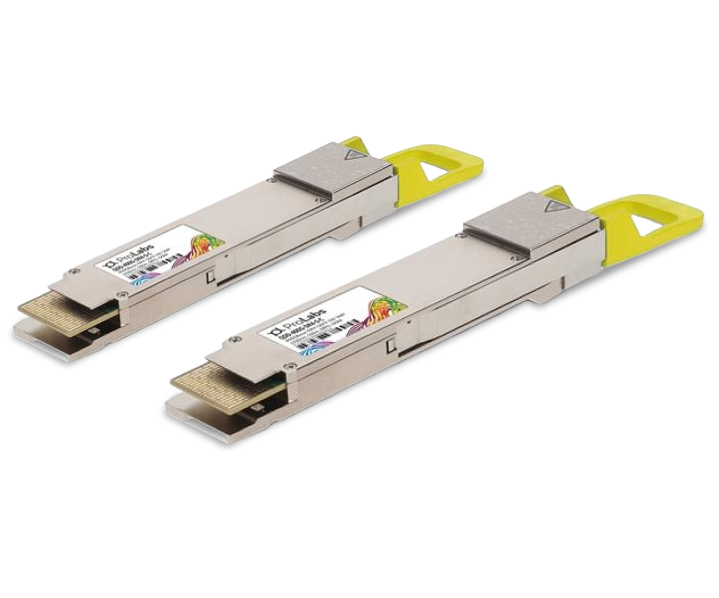
2 Matching results
QDD-400G-DR4-S-C (400G QSFP-DD Transceiver, 400GBASE-DR4, MPO-12 500m Parallel SMF Cisco Compatible)
5 (5)- Transceiver
- Orm
- QSFP-DD
- 400G
- LC
- 1310 nm
- Short-Range
Est Value In stock
First-Time Buyer Discount – Get up to 2% additional off on your first order
ORM Rewards Earn $50 in Rewards + Free Expedited Delivery – Join Now!
Use eCoupon ORMSAVE10
eCoupon limited to 5 units
QDD-400G-FR4-S-C (400G QSFP-DD Transceiver, 400G-FR4, LC 2km SMF Cisco Compatible)
4.6 (5)- Transceiver
- Orm
- QSFP-DD
- 400G
- LC
- 1310 nm
- Long-Range
Est Value In stockFirst-Time Buyer Discount – Get up to 2% additional off on your first order
ORM Rewards Earn $50 in Rewards + Free Expedited Delivery – Join Now!
Use eCoupon ORMSAVE10
eCoupon limited to 5 units

ORM Sales Advisors
Buying for your business? Get a personalised quote in under 2 hours. Talk to an expert
LEARNFilters (2) 
Questions & Answers
What is Cisco Compatible QSFP-DD?
Cisco Compatible QSFP-DD is an eight-lane, high-density pluggable transceiver module compliant with the QSFP-DD MSA, engineered to deliver up to 400 Gbps per port in Cisco switches, routers, and data-center equipment.
Which data rates does Cisco Compatible QSFP-DD support?
Cisco Compatible QSFP-DD modules support lane speeds up to 50 Gbps, aggregating to 200 Gbps or 400 Gbps per port, enabling Ethernet, InfiniBand, and OTN applications in enterprise and hyperscale networks.
What fiber types and link distances are supported?
Depending on the module variant, Cisco Compatible QSFP-DD supports multimode fiber (OM3/OM4) for up to 150 m, single-mode OS2 fiber for up to 10 km or 40 km, and DWDM options for up to 80 km.
Is Cisco Compatible QSFP-DD backward compatible with QSFP28 ports?
Yes. Cisco Compatible QSFP-DD is backward compatible with QSFP28 ports via a QSFP-DD to QSFP28 adapter cage, allowing seamless operation at 100 Gbps in legacy Cisco QSFP28 slots.
How do I verify compatibility with Cisco hardware?
Verify compatibility by matching the Cisco hardware firmware version, checking the Cisco compatibility matrix, and confirming the QSFP-DD MSA compliance statement provided by the transceiver vendor.
What diagnostic features are available?
Cisco Compatible QSFP-DD modules support Digital Diagnostics Monitoring (DDM/DOM) for real-time monitoring of optical power, temperature, voltage and laser bias current via the I²C interface.
How do I install a Cisco Compatible QSFP-DD module?
To install, power down the port if required, align the module with the port, gently insert until the latch engages, then power up and verify link status via Cisco IOS or NX-OS show commands.
What is the typical power consumption?
Typical power consumption ranges from 5 W to 12 W per module, depending on fiber type and rate. Refer to the vendor datasheet and Cisco platform Q‐series power guidelines for precise budgeting.
Which applications are ideal for Cisco Compatible QSFP-DD?
Ideal applications include 5G fronthaul, hyperscale data-center spine and leaf, high-performance computing clusters, and next-generation carrier Ethernet requiring high-density, high-speed interconnects.
What physical form factor and MSA compliance does it use?
Cisco Compatible QSFP-DD adopts the QSFP-DD MSA form factor, featuring a 16-lane electrical interface on a QSFP footprint. It meets all mechanical, power, and thermal specifications defined in the QSFP-DD specification.
Can I use Cisco Compatible QSFP-DD for breakout applications?
Yes. Using a 400 Gbps to 4×100 Gbps breakout cable or adapter, a Cisco Compatible QSFP-DD port can split into four independent 100 Gbps links, provided the Cisco switch supports breakout functionality.
What temperature range do these modules operate in?
Cisco Compatible QSFP-DD modules typically operate in the commercial range of 0 °C to +70 °C. Extended or industrial temperature variants are available for –40 °C to +85 °C in harsh-environment deployments.
How do I troubleshoot link-up issues?
Verify fiber polarity, cleanliness, and insertion depth. Check DDM readings for power or temperature anomalies, confirm Cisco platform port configuration, and ensure firmware matches the transceiver compatibility matrix.
How do I choose between active and passive cables?
Choose passive DACs for links up to 3 m to minimize cost. For distances beyond 5 m or for reduced power and extended reach, select active DACs or AOCs with integrated signal amplification.
What are the benefits of Cisco Compatible QSFP-DD vs. OEM modules?
Advantages include cost savings, flexibility in sourcing, adherence to MSA interchangeability, and support for Cisco diagnostics, provided the module is Cisco-listed and tested for full interoperability.
How can I ensure I’m purchasing a genuine Cisco Compatible module?
Purchase from Cisco-authorized resellers, verify the Cisco fit-for-purpose list, request MSA compliance certificates, and use Cisco IOS/NX-OS show commands to confirm vendor and part-number authenticity.